Technical comparative analysis of technological alternatives for whey valorization via protein microparticulation.
The treatment of cheese whey has evolved from an environmental challenge into the primary driver for expanding gross margins in the dairy industry. The key to this valorization lies in whey protein microparticulation, a thermo-mechanical process that transforms native soluble proteins (mainly beta-lactoglobulin and alpha-lactalbumin) into stable spherical microaggregates that emulate the behavior of fat globules.
This article details the various technological solutions available in the market—ranging from traditional layouts with a downstream high-pressure homogenizer to off-the-shelf packaged systems and fragmented peripheral lines—comparing them directly against the integrated monoblock reactor architecture with simultaneous kinetic shearing developed by Perinox. It evaluates how controlling the Volumetric Particle Size Distribution (PSD) curve between 1 and 10 µm prevents textural defects, minimizes thermal fouling, and allows up to 80% of whey protein to be retained in the curd, achieving real cheese yield increases exceeding 20%.
Physicochemical Foundations of Whey Protein Microparticulation
To properly evaluate competing technological options, it is essential to understand the denaturation and aggregation kinetics of whey proteins during processing:
- Thermal Denaturation (Thermal Treatment > 65 °C): Upon exceeding the critical denaturation temperature, beta-lactoglobulin unfolds its globular tertiary structure, exposing free sulfhydryl (–SH) groups to the aqueous phase.
- Intermolecular Disulfide Bond Formation: Free –SH groups react covalently with one another via S–S links, establishing macromolecular networks.
- Shear-Induced Sizing Mechanism: Applying a specific shear rate (γ̇ in s⁻¹) to the fluid shapes the forming macrogels, breaking them down into stable spherical microaggregates.
The Critical Particle Size Distribution (PSD) Window
For the resulting ingredient to integrate effectively into the cheese matrix, the size of the aggregates must remain strictly bounded:
- Particles < 1.0 µm: Fail to entrap within the calcium paracaseinate network and are lost in the whey phase.
- Particles > 10.0 µm: Disrupt curd cohesion and produce an undesirable floury or gritty mouthfeel.
- Optimal Window (1.0 to 10.0 µm): Geometrically equivalent to milk fat globules. The primary engineering target is to concentrate over 95% of all particles strictly within this range.
Comparative Analysis of Technological Alternatives
Industrial processors employ various engineering configurations to treat Whey Protein Concentrate (WPC). Below is an evaluation of their operating principles and technical drawbacks compared to the monoblock reactor standard.
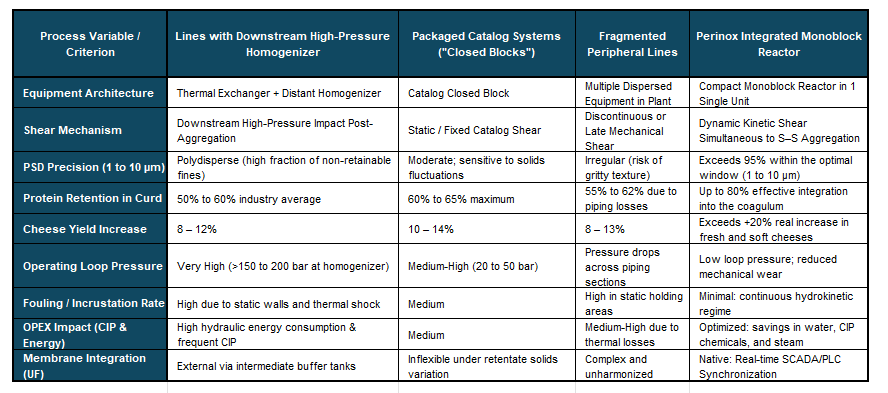
1. Lines Based on Heat Exchangers with Downstream High-Pressure Homogenizers
- Engineering Approach: Concentrated whey is heated using conventional tubular or scraped-surface heat exchangers, held in holding tubes, and subsequently routed to a mechanical high-pressure homogenizer to fracture the formed gels.
- Technical Limitations:
- Delayed Shear Outside the Aggregation Window: Applying shear after the protein gel has thermally consolidated causes hydraulic shock that fractures particles heterogeneously. This yields a highly polydisperse PSD curve with significant fine fractions that escape curd retention.
- Accelerated Thermal Fouling: Heating proteins on static surfaces without simultaneous shear accelerates protein deposition along metallic walls. This forces high operating loop pressures, elevates energy consumption (kWh/m³), and mandates frequent shutdowns for chemical CIP cleaning.
2. Off-the-Shelf Packaged Systems (“Closed Blocks”)
- Engineering Approach: Pre-engineered catalog modules combining indirect thermal treatment with static or fixed mechanical shearing.
- Technical Limitations:
- Rigidity Against Raw Material Variations: Total solids in the ultrafiltration (UF) retentate fluctuate daily based on incoming milk composition. As standardized modules, their ability to adjust shear rates in real time is limited.
- Non-Native External Coupling: Lacking native integration with plant membrane systems, overall mass balances experience frequent misalignments.
3. Fragmented Peripheral Lines (Independent Equipment)
- Engineering Approach: Processes configured by interconnecting standalone units: thermal denaturers, mixing tanks, extended holding pipes, and peripheral shear units.
- Technical Limitations:
- Thermal Drops and Head Loss: Extended interconnecting lines induce temperature fluctuations and hydraulic pressure losses, destabilizing the residence time required for native protein conversion.
- Large Footprint: Requires substantial floor space and increases critical maintenance points.
The Perinox Solution: Integrated Monoblock Reactor with Simultaneous Kinetic Shear
Perinox engineering developed an automated compact monoblock reactor that performs thermal denaturation and mechanical shearing continuously and simultaneously.
- Shearing at the Exact Instant of Cross-Linking (S–S): Shear forces act precisely as molecules establish disulfide cross-links under thermal gradients. This ensures >95% of particles remain stably sized between 1 and 10 µm, eliminating gritty textures and maximizing curd retention.
- Low-Pressure Operation and Minimal Fouling: Constant hydrokinetic agitation across the thermal profile sharply reduces protein baked-on fouling on reactor walls. This lowers loop pressure, extends continuous production runs, and delivers significant savings in water, power, and CIP chemicals.
- Native Filtration Membrane Integration: Units are factory-integrated with Perinox UF/RO membrane systems. SCADA control systems automatically regulate shear regimes relative to incoming solids mass flow.
Process Flow and Plant Integration Architecture
To achieve maximum conversion efficiency, the microparticulation process follows five integrated thermo-hydraulic stages:
- Stage 1: Raw Material Reception & Feeding — Sweet or acid cheese whey, clarified and fat-separated.
- Stage 2: Membrane Pre-Concentration (UF / RO) — Tangential filtration removing permeate (water/lactose) to concentrate serum nitrogen to WPC35–WPC60 levels.
- Stage 3: Perinox Continuous Monoblock Reactor (Native SCADA/PLC Synchronization) — Guided thermal denaturation (> 65 °C) paired with dynamic kinetic shear during disulfide bond formation.
- Stage 4: Production of Stable Microparticulated Protein — Volumetric Particle Size Distribution (PSD) achieves >95% concentration within 1.0–10.0 µm, neutralizing the risk of texture grittiness.
- Stage 5: Re-incorporation into Cheese Making Milk — Whey protein retention in curd reaches up to 80%, yielding a net increase in cheese output exceeding +20%.
Value Proposition
Selecting the optimal technological alternative dictates long-term plant profitability:
- Profitability per Treated m³: Trapping up to 80% of whey proteins inside the curd matrix drives a cheese yield gain of >20%, accelerating capital ROI.
- OPEX Optimization: Low-pressure, anti-fouling operational design cuts energy draw, reduces CIP chemical usage, and prolongs uninterrupted manufacturing cycles.
- Guaranteed End-Product Quality: Controlled PSD (>95% between 1–10 µm) guarantees a smooth, homogenous texture free of mealiness or grit.
Frequently Asked Questions (FAQ)
1. What is the advantage of simultaneous shear microparticulation over downstream high-pressure homogenization?
Traditional downstream high-pressure homogenization acts destructively on protein macrogels that have already consolidated inside static heat exchangers. This leads to unrefined PSD curves, generates un-retainable fines, and accelerates thermal wall fouling. The Perinox monoblock reactor applies shear force simultaneously while S–S disulfide bonds are actively forming. This prevents macrogelation without requiring extreme hydraulic pressures, lowering energy draw, curtailing wall adhesion, and extending operational run times between CIP cycles.
2. How does Perinox technology prevent gritty or floury textures in microparticulated dairy products?
A gritty or floury mouthfeel occurs when protein aggregates exceed 10 µm in diameter. The Perinox monoblock reactor maintains a continuous hydrokinetic shear regime that locks over 95% of particles inside the 1 to 10 µm range. This dimension is geometrically analogous to native milk fat globules, allowing seamless integration into cheese or yogurt matrices without altering sensory perception.
3. Why is native integration between filtration membranes (UF) and the microparticulation reactor critical?
Fluctuations in protein solids within incoming whey retentate disrupt standard thermal treatment cycles. Native integration links the membrane filtration plant’s SCADA system directly with the thermal reactor. This enables real-time auto-adjustment of shear rates and thermal energy input based on feed conditions, guaranteeing predictable cheese yield increases (>20%) and optimized utility usage.
Content Related
Whey Protein Upcycling via Microparticulation Technology
Whey Valorization and treatment
References
- ASME. (2022). Bioprocessing Equipment Standard (ASME BPE-2022). The American Society of Mechanical Engineers. https://www.asme.org/codes-standards/find-codes-standards/bpe-bioprocessing-equipment
- EHEDG. (2020). Hygienic Design Principles for Food Processing Equipment (Doc. 8). European Hygienic Engineering & Design Group. https://www.ehedg.org/
- Fox, P. F., Uniacke-Lowe, T., McSweeney, P. L. H., & O’Mahony, J. A. (2015). Dairy Chemistry and Biochemistry (2nd ed.). Springer International Publishing. https://doi.org/10.1007/978-3-319-14892-2
- International Dairy Federation (IDF). (2021). Whey Processing and Protein Fractionation Technologies (Bulletin N° 512/2021). IDF World Dairy Summit. https://fil-idf.org/
- ISO/TS 22002-1:2009. (2009). Prerequisite programmes on food safety — Part 1: Food manufacturing. International Organization for Standardization. https://www.iso.org/standard/44001.html
- Mahaut, B., Jeantet, R., Brulé, G., & Schuck, P. (2019). Productos lácteos industriales (2.ª ed.). Editorial Acribia. https://www.editorialacribia.com/
- Perinox, S. A. (2024). Soluciones tecnológicas para la Industria Láctea: Manual técnico de Microparticulación de Proteínas de Suero y Filtración por Membranas. Archivo técnico corporativo, Villarrobledo, España[cite: 1, 2, 3, 11]. https://www.perinox.com
- Spiegel, T. (2004). Whey protein microparticulation by heat treatment and homogenous shear in a scoured-surface heat exchanger. International Dairy Journal, 14(3), 217–231. https://doi.org/10.1016/j.idairyj.2003.07.001
- Walstra, P., Wouters, J. T. M., & Geurts, T. J. (2006). Dairy Technology: Principles of Milk Properties and Processes. CRC Press. https://doi.org/10.1201/9780203913291