Non-thermal process engineering, recovery of bioactive proteins, and automated CIP/SIP sanitation in the transformation of industrial animal by-products.
Slaughterhouse blood and its derivatives represent one of the most complex wastewater and effluent streams in the meat processing industry due to an exceptionally high organic load, with Chemical Oxygen Demand (COD) values ranging between 150,000 mg O2/L and 250,000 mg O2/L. However, from a process engineering perspective, blood constitutes a high-value biological matrix rich in proteins and bio-functional compounds.
The implementation of non-destructive crossflow membrane filtration (tangential flow filtration) enables the efficient fractionation, clarification, concentration, and selective diafiltration of native plasma proteins, including Immunoglobulin G (IgG), serum albumin, and hemoglobin.
This technical article outlines the physicochemical fundamentals, critical operating parameters—such as Transmembrane Pressure (TMP), wall shear stress, and automated Clean-In-Place (CIP) protocols—and engineering applications required to transform industrial slaughterhouse by-products into high-value protein ingredients for animal nutrition and functional food systems.
Physicochemical Fundamentals of Crossflow Membrane Filtration in Biological Fluids
Unlike dead-end (conventional) filtration, where suspended solids accumulate perpendicularly on the filter medium to form an incompressible cake that restricts permeate flow, crossflow membrane filtration drives the feed stream parallel to the active membrane surface.
This tangential crossflow velocity (typically maintained between 2.0 m/s and 6.0 m/s) generates high hydrodynamic shear stress at the membrane boundary wall. The shear stress continuously sweeps the boundary layer, drastically reducing concentration polarization and controlling the rate of membrane fouling.
The primary driving force across the separation layer is the Transmembrane Pressure (TMP), which establishes the hydraulic equilibrium between the inlet, outlet, and permeate pressures:
TMP = ((P_inlet + P_outlet) / 2) – P_permeate
The volumetric permeate flux per unit membrane area (J, expressed in L/m²·h or LMH) is modeled by Darcy’s Law modified for synthetic membrane operations:
J = TMP / (μ · (R_m + R_f))
Where:
- TMP: Driving transmembrane pressure (bar or kPa).
- μ: Dynamic viscosity of the biological fluid (Pa·s).
- R_m: Intrinsic hydraulic resistance of the clean membrane (m⁻¹).
- R_f: Additional resistance caused by protein gel layer formation, solute adsorption, and pore blocking (m⁻¹).
Technical Membrane Cascade for Blood Fractionation
Complete valorization of whole blood requires a multi-stage membrane cascade engineered around molecular size constraints and targeted Molecular Weight Cut-Off (MWCO) thresholds:
- Microfiltration (MF: 0.1 to 1.0 µm): Deployed during initial clarification and defatting. MF isolates intact cellular structures, erythrocyte stroma, and lipid aggregates without shearing or denaturing soluble plasma proteins.
- Ultrafiltration (UF: 1 to 100 kDa): The core unit operation in blood plasma fractionation. UF selectively retains and concentrates high-molecular-weight proteins, such as Immunoglobulin G (IgG, ~150 kDa) and Bovine Serum Albumin (BSA, ~66.5 kDa).
- Nanofiltration (NF: 200 to 1,000 Da): Employed during continuous diafiltration (desalting) of concentrated protein streams and for the concentration of low-molecular-weight bioactive peptides.
- Reverse Osmosis (RO): Used for polishing highly diluted effluent streams and purifying permeate water, enabling closed-loop water reuse across processing facilities.
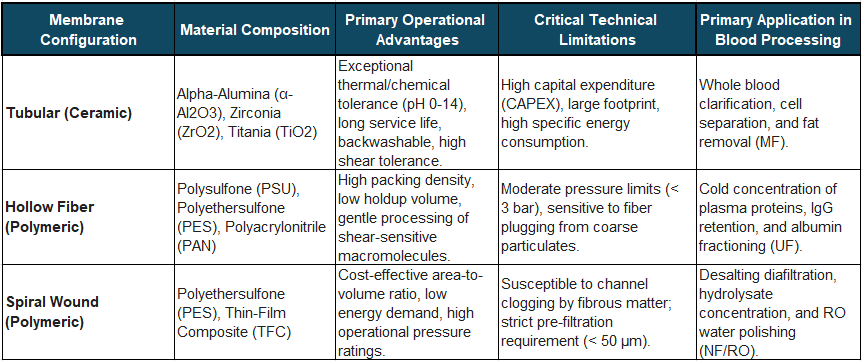
Technical Comparison of Membrane Configurations for Biological Fluids
The geometry and material selection of the membrane dictate hydraulic efficiency, chemical and thermal durability, and cleaning recovery performance.
Automated CIP/SIP Protocols and Industry 4.0 Digital Integration
Fractionating protein-rich biological fluids requires rigorous chemical cleaning procedures to prevent biofilm formation and irreversible gel layer fouling without degrading membrane integrity. Equipment designs must conform to 3-A Hygienic Standards and ASME BPE guidelines.
Clean-In-Place (CIP) Automated Protocol
- Pre-Rinse: Softened water flush at 35 °C to 40 °C to remove non-bound organic matter while avoiding thermal coagulation of native proteins.
- Alkaline-Enzymatic Wash: Sodium hydroxide (NaOH, 0.8% to 1.5% w/w) combined with surfactants and proteolytic enzymes at 50 °C to hydrolyze and dissolve the protein gel layer.
- Acid Neutralization Rinse: Nitric acid (HNO3) or phosphoric acid (H3PO4) solution (0.5% to 1.0% v/v) at 45 °C to remove mineral scale and calcium/iron precipitates.
- Final Sanitization: Peracetic acid application (0.1% to 0.2%) or thermal sanitization with hot water (> 85 °C for ceramic systems).
Industry 4.0 Process Control
Integrating Programmable Logic Controllers (PLC) and SCADA systems enables real-time management of process variables:
- Adaptive TMP Control: Dynamic modulation of variable frequency drives (VFD) on feed pumps to maintain permeate flux within the sub-critical flux zone, preventing irreversible membrane compaction.
- In-Line Turbidimetry and Conductivity: Real-time monitoring to detect immediate fiber breaches or membrane integrity failures and precise endpoint determination during diafiltration steps.
Industrial Applications in Nutrition and Sustainability
High-Value Animal Feed and Pre-Starters
- Plasma Immunoglobulins (IgG): Cold ultrafiltration concentrates intact immunoglobulins while preserving their native tertiary structure. Incorporating IgG into swine pre-starter diets and milk replacers boosts gut immunity and reduces reliance on prophylactic antibiotics.
- Soluble Hemoglobin: Microfiltration combined with ultrafiltration yields highly soluble, bioavailable heme iron sources designed for aquaculture and specialized animal feeds.
Functional Food Ingredients
- Serum Albumin Isolates: Ultrafiltration and diafiltration (UF/DF) remove unwanted salts and low-molecular-weight compounds, yielding an isolate with high gelation, foaming, and emulsification performance.
- Bioactive Peptides: Nanofiltration of enzymatic hydrolysates isolates specific peptide fractions displaying targeted antioxidant and ACE-inhibitory (antihypertensive) activities.
Process Water Recovery and Polishing
- Implementing Reverse Osmosis (RO) systems to polish process permeate streams enables factory-wide water reuse in cooling towers and primary equipment washdowns, reducing overall water intake and environmental footprint.
Engineering Summary
Crossflow membrane filtration delivers a superior technical alternative to conventional thermal evaporation and spray drying alone. By operating under non-thermal conditions, tangential flow systems preserve the biological functionality of high-value plasma proteins while minimizing energy consumption and operational costs in slaughterhouse by-product valorization.
Related content
Blood and blood-derived products technology
Some projects developed
Crossflow membrane filtration for water recovery in industrial processes
Industrial liquid valorization using crossflow membrane filtration
Animal Blood Plasma Filtration: Industrial Concentration of High-Value Biological Fluids
Bibliographic References
- Cheryan, M. (1998). Ultrafiltration and Microfiltration Handbook. CRC Press. https://doi.org/10.1201/9781482278743
- European Integrated Pollution Prevention and Control Bureau (EIPPCB). (2019). Best Available Techniques (BAT) Reference Document for the Slaughterhouses and Animal By-products Industries. Joint Research Centre, European Commission. https://eippcb.jrc.ec.europa.eu/reference/slaughterhouses-and-animal-by-products-industries
- Mulder, M. (1996). Basic Principles of Membrane Technology. Springer Netherlands. https://doi.org/10.1007/978-94-009-1766-8
- Toldrá, F., Aristoy, M. C., Mora, L., & Reig, M. (2012). Innovations in value-addition of edible meat by-products. Meat Science, 92(3), 290-296. https://doi.org/10.1016/j.meatsci.2012.04.004
- van der McNair, A., & DeSilva, K. (2020). Hygienic design and CIP optimization in cross-flow membrane systems for biological fluids. Journal of Membrane Science & Technology, 48(2), 112-125. https://doi.org/10.1016/j.memsci.2020.112125