


Ensuring maximum electrochemical efficiency and stack durability through continuous control of resistivity (18.2 MΩ·cm), TOC, and ionic traces via high-precision filtration schemes.
Industrial green hydrogen generation via water electrolysis has established itself as a fundamental pillar of decarbonization in hard-to-abate sectors. However, the thermodynamic performance of Proton Exchange Membrane (PEM), Anion Exchange Membrane (AEM), and Solid Oxide Electrolyzer Cells (SOEC) is strictly governed by feed water quality. Traces of divalent cations, colloidal silica, or organic matter in raw water irreversibly degrade the electrodes and the polymer membrane of the stack, increasing overpotential and drastically reducing operational lifespan.
This technical article outlines the conceptual and operational architecture of integrated Ultrapure Water (UPW) production systems. Through a combination of multi-stage membrane filtration (UF/NF), double-pass reverse osmosis (DPRO), continuous electrodeionization (EDI), and high-precision final polishing, these systems yield a process fluid with a constant resistivity of 18.2 MΩ·cm (0.055 µS/cm at 25 °C) and total organic carbon (TOC) levels below 5 ppb, transforming complex industrial water or municipal supplies into electrochemical-grade reagent water.
Impurities in Electrolysis: Physicochemical Degradation Mechanisms
In the global electrochemical water-splitting reaction:
2 H₂O (l) ⟶ 2 H₂ (g) + O₂ (g) (Gibbs Free Energy: ΔG = +237.2 kJ/mol)
Water acts not merely as a mass transport medium, but as the direct reactant in the Oxygen Evolution Reaction (OER) at the anode and the Hydrogen Evolution Reaction (HER) at the cathode.
When feed water fails to meet stringent microbiological, ionic, and organic limits, three main electrochemical degradation mechanisms occur:
- Catalyst poisoning and active Site blockade: Metallic cations such as Fe³⁺, Cu²⁺, or Ni²⁺ compete with protons (H⁺) at platinum and iridium active centers, increasing charge transfer resistance (R_ct) and driving up overall cell voltage (V_cell).
- Ion Exchange Membrane Scaling (PEM): Alkaline earth cations (Ca²⁺, Mg²⁺) precipitate as carbonates and hydroxides within the perfluorosulfonic acid (PFSA) membrane pores, displacing –SO₃⁻ acid groups and severely reducing proton conductivity (σ_H).
- Organic fouling and halide corrosion: Dissolved organic matter (measured as TOC) forms passivating films on the Porous Transport Layer (PTL), while halide ions like chloride (Cl⁻) induce pitting corrosion on titanium bipolar plates.
Ultrapure Water (UPW) Quality Requirements
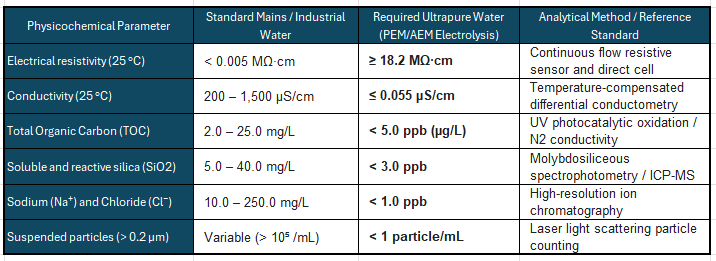
To ensure stack operational durability exceeding 60,000 hours, processed water must meet strict purity standards such as ASTM D1193 (Type I) and ISO 3696 (Grade 1).
Multi-Stage Purification System Architecture
Designing a reliable ultrapure water generation line requires the coordinated integration of membrane separation, electrochemical demineralization, and mixed-bed polishing. Therefore, the chain can be modeled using a modular framework consisting of four sequential stages:
1. Advanced Cross-Flow Ultrafiltration Pretreatment
Raw feed water—sourced from municipal grids, wells, or industrial process effluents—undergoes cross-flow ultrafiltration (UF). Featuring a molecular weight cut-off (MWCO) between 10 kDa and 100 kDa, the UF module removes 99.9% of suspended solids, bacteria, colloidal silica, and organic macromolecules. This maintains a Silt Density Index (SDI₁₅) below 2.0, preventing membrane fouling in downstream stages.
2. Double-Pass Reverse Osmosis (DPRO) Desalination
Filtered permeate feeds the industrial reverse osmosis system. By applying hydraulic pressure higher than the osmotic pressure (P_hyd > Δπ), thin-film composite (TFC) polyamide membranes reject 99.5% of Total Dissolved Solids (TDS).
To maximize purity prior to electrodeionization, the sequential double-pass configuration (Pass 1 + Pass 2) incorporates intermediate pH adjustment to convert dissolved carbon dioxide (CO₂) into bicarbonate (HCO₃⁻), enabling high-efficiency retention by the second-pass membrane.
3. Continuous Electrodeionization (EDI) Deionization
Therefore, as an alternative to using traditional mixed-bed ion exchange resins that require periodic regeneration with aggressive chemical reagents continuous electrodeionization (EDI) modules can be integrated.
EDI combines cation-selective (MC) and anion-selective (MA) membranes, ion-exchange resins within diluate compartments, and a direct current (DC) electric field. Under the applied potential difference:
- Cations (Na⁺, Ca²⁺) and anions (Cl⁻, SO₄²⁻) migrate across the selective membranes into concentrate channels.
- Continuous water splitting (H₂O ⟶ H⁺ + OH⁻) constantly regenerates the ion-exchange resin in situ.
- Demineralized water with a resistivity of 16 to 18 MΩ·cm is produced continuously without generating hazardous chemical wastewater.
4. TOC Photocatalytic Oxidation and Final Polishing
The EDI permeate passes through a dual-wavelength UV reactor (185 nm / 254 nm). The 185 nm wavelength photolyzes water molecules to generate hydroxyl radicals (•OH), which break down residual organic traces into CO₂ and H₂O.
A final polishing loop containing nuclear-grade ion-exchange resins adsorbs trace dissolved carbon dioxide, continuously delivering an effluent at the theoretical purity limit of 18.2 MΩ·cm.
Efficient green hydrogen production demands integrated solutions combining process engineering, membrane separation, and operational sustainability. Modern ultrapure water systems remove recurring chemical regeneration costs and environmental liabilities, delivering a feedstock suitable for high-duty electrolysis.
Related Content
- Ultrapure Water Production Systems
- Industrial Wastewater Reuse via Membrane Filtration for Green Hydrogen Generation
- Alternative Energy Solutions
Frequently Asked Questions (FAQ)
1. Why can’t a PEM electrolyzer operate on standard tap water or conventional demineralized water?
Standard tap or demineralized water typically exhibits a conductivity between 5 µS/cm and 50 µS/cm, representing significant concentrations of ions like Ca²⁺, Mg²⁺, and Cl⁻. In a PEM cell, these ions deposit onto the proton exchange membrane and deactivate the iridium/platinum catalyst, causing severe overpotential losses and destroying the stack within a few hundred hours of operation.
2. What advantages does Electrodeionization (EDI) offer over mixed-bed resin tanks in green hydrogen plants?
Electrodeionization (EDI) operates continuously using electrical current to regenerate its resins in situ. This eliminates the storage and handling of hazardous chemicals (HCl and NaOH), avoids off-site resin regeneration expenses, and removes downtime associated with batch resin exhaustion.
3. How does ultrafiltration pretreatment impact energy consumption in UPW generation plants?
Ultrafiltration efficiently removes colloids and suspended particulates that cause membrane fouling in reverse osmosis stages. Maintaining optimal pretreatment keeps transmembrane pressure (TMP) within target design limits, preventing excess power draw from high-pressure pumps and reducing the specific energy consumption (kWh/m³) of the water plant.
References & technical sources:
- ASTM International. (2018). Standard Specification for Reagent Water (ASTM D1193-06R18). ASTM International. https://www.astm.org/d1193-06r18.html
- International Organization for Standardization. (1987). Water for analytical laboratory use — Specification and test methods (ISO Standard No. 3696:1987). ISO. https://www.iso.org/standard/9169.html
- Mouli, C., & Srinivas, K. (2023). Impact of water purity and impurities on proton exchange membrane water electrolysis performance: A comprehensive review. Journal of Power Sources, 556, 232450. https://doi.org/10.1016/j.jpowsour.2022.232450
- Perinox. (2026). Filtración tangencial por membranas en la recuperación de agua y producción de hidrógeno verde. Perinox Tecnologías Industriales. https://perinox.com/filtracion-tangencial-membranas-hidrogeno-verde/
- Perinox. (2026). Más de 40 años innovando en el tratamiento de fluidos industriales y tecnologías de separación. Perinox Corporativo. https://perinox.com/perinox-40-anos-tratamiento-fluidos-industriales/
Image credits: Photo by Rick Rothenberg via Unsplash; photographic image via Canva.
*Content generated, edited, and peer-reviewed by the Perinox engineering and technical team with AI support.


