To enhance the recovery of high-value protein ingredients, a leading dairy processing enterprise selected Perinox for the design, fabrication, and commissioning of a skim milk microfiltration system.
The project required integrating state-of-the-art separation technology into an existing production line utilizing crossflow membrane filtration (CMF) architecture.
The primary objective of the system is to concentrate native micellar casein (MCC) while preserving its structural integrity, while simultaneously generating a high-purity permeate stream composed of native serum proteins (α-lactalbumin and β-lactoglobulin), ideal for premium infant formulas and clinical nutrition products.
Project Technical Data Sheet
| Process Parameter | Technical Specification / Operating Range |
| Applied Technology | Crossflow Membrane Filtration |
| Specific Process | Skim Milk Microfiltration (MF) |
| Pore Size ($d_{\text{pore}}$) | $0.1\text{ to }0.2\,\mu\text{m}$ (micrometers) |
| Primary Objective | Concentration of Native Micellar Casein Concentrate (MCC) |
| Upgraded By-product | Native serum protein permeate stream for pediatric & medical nutrition |
| Assembly & Commissioning | Custom pre-engineering by Perinox, on-site installation, and integrated CIP system |
| Support & Monitoring | Remote technical teleassistance and real-time digital process monitoring (Industry 4.0) |
Key Applications of Microfiltration in Dairy Processing
- Fractionation and Concentration of Micellar Casein (MCC): Selectively retains protein micelles in their native un-denatured form, yielding concentrates with exceptional nutritional, gelation, and emulsification functionality.
- Production of Native Serum Proteins: The permeate stream selectively recovers non-denatured β-lactoglobulin and α-lactalbumin with virtually zero fat content and superior digestibility for infant and medical applications.
- Microbial Load Reduction & Clarification: Separates bacteria, bacterial spores, and residual fat globules, improving stream purity and extending overall shelf-life.
Technical Foundations of Skim Milk Microfiltration
Microfiltration (MF) via crossflow membrane filtration operates optimally within a pore size range of 0.1 to 0.2 µm. This technology leverages the size differential between casein micelles (~100–300 nm) and soluble whey proteins (~2–15 nm) to physically fractionate milk without chemical additives or acidification processes.
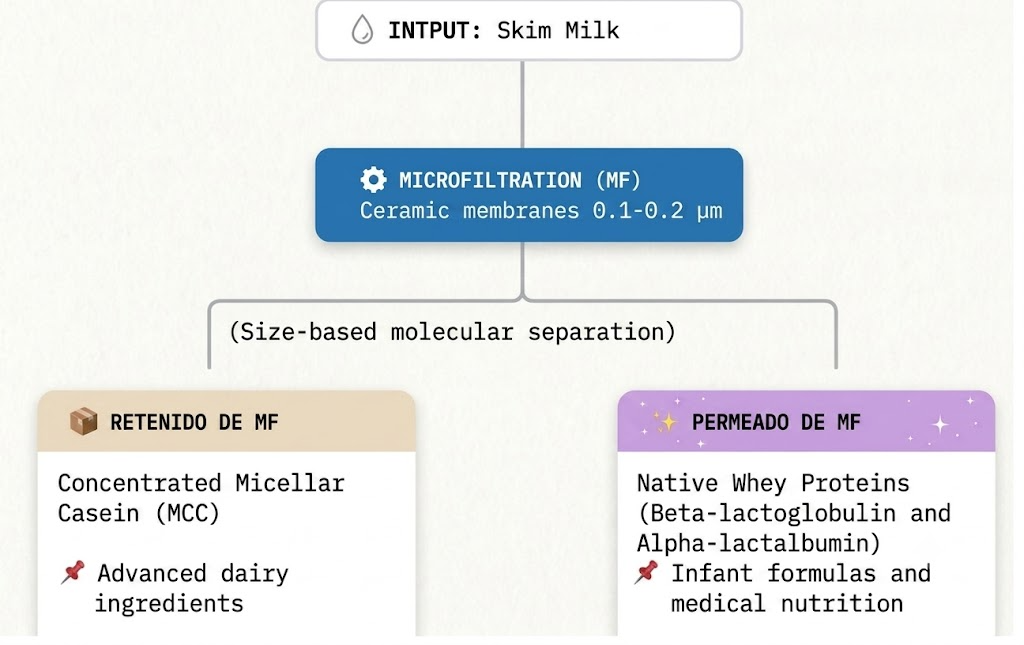
Key Technical Distinction: Microfiltration (MF) vs. Ultrafiltration (UF)
- Ultrafiltration (UF): Retains total milk proteins (both casein micelles and whey proteins) using membranes with a Molecular Weight Cut-Off (MWCO) of 5 to 100 kDa, primarily utilized for total protein standardization.
- Microfiltration (MF): Utilizing pore sizes of 0.1 – 0.2 µm, it permits the selective passage of soluble whey proteins into the permeate while retaining casein micelles (diameter Ø ≈ 100 – 300 nm), directly controlling and customizing the casein-to-whey ratio.
Operational Advantages of Micellar Casein Concentration
- Native Functional Protein Ingredient: Preserves the native mineral matrix (calcium and phosphorus complexes) without subjecting proteins to aggressive chemical or thermal degradation.
- Precise Protein Profile Standardization: Enables exact control over ingredient ratios for constant, repeatable end-product formulations.
- Repeatable & Stable Processing: Maintains homogeneous, batch-to-batch operational parameters in drying or packaging lines.
- Operating Cost Optimization: High separation efficiency minimizes transformation energy and maximizes raw material utilization.
- Complete By-Product Upgrading: Transforms whey permeate into an ultra-premium revenue stream targeted at high-margin markets like infant formula and clinical supplements.
Project Integration and Plant Commissioning
Installation and commissioning of the industrial plant (engineered for a major dairy facility in Ecuador) were completed in a three-week timeframe in close collaboration with the customer’s technical personnel:
- Design & Engineering: Supervision, pre-engineering assessment, and custom hydraulic matching to fit existing processing line capacity.
- Rapid Interconnection: Equipment placement and pipework interconnection executed directly by client staff under expert Perinox technical guidance.
- Remote Assistance & Industry 4.0: Integrated teleassistance capabilities allow real-time monitoring of operational variables (transmembrane pressure TMP, flow rates, and CIP wash cycles) for immediate troubleshooting.
Related Technical Content
When tangential flow filtration is not the best separation solution
Volume, fluid value and efficiency: key factors for investing in industrial filtration technologies
Crossflow membrane filtration system for milk processing
Frequently Asked Questions (FAQ)
Q1: What is the difference between concentrating casein via microfiltration versus acid precipitation?
Answer: Membrane microfiltration is a purely physical separation process conducted at low temperatures that preserves casein in its native micellar structure along with intact colloidal calcium-phosphate complexes. In contrast, acid precipitation chemically alters the protein’s tertiary structure and demineralizes the micelle, significantly reducing its solubility, emulsification, and functional properties.
Q2: Why is microfiltration permeate highly valued in infant nutrition?
Answer: The permeate obtained from skim milk microfiltration consists of un-denatured native serum proteins ($\alpha$-lactalbumin and $\beta$-lactoglobulin). Because it does not originate from cheese making (rennet coagulation), it is entirely free of glycomacropeptides (GMP), contains negligible fat, and offers an ideal amino acid profile with superior digestibility for infant formulas and medical nutrition.
Q3: What types of membranes are used for fractionating micellar casein?
Answer: Tubular ceramic membranes or spiral-wound polymeric membranes with a pore size range of $0.1\text{ to }0.2\,\mu\text{m}$ are typically used. These membranes provide high mechanical and thermal resistance, allowing deep cleaning-in-place (CIP) cycles and operating under uniform Transmembrane Pressure ($\text{TMP}$) control to avoid premature membrane fouling.
Q4: Can a Perinox microfiltration system be integrated into an existing processing line?
Answer: Yes. The microfiltration skid is designed following a detailed pre-engineering phase that evaluates plant capacity, available footprint, flow rates, and utility supplies. This ensures rapid interconnection without disrupting ongoing operations, while incorporating remote teleassistance and Industry 4.0 monitoring for real-time filtration performance oversight.